

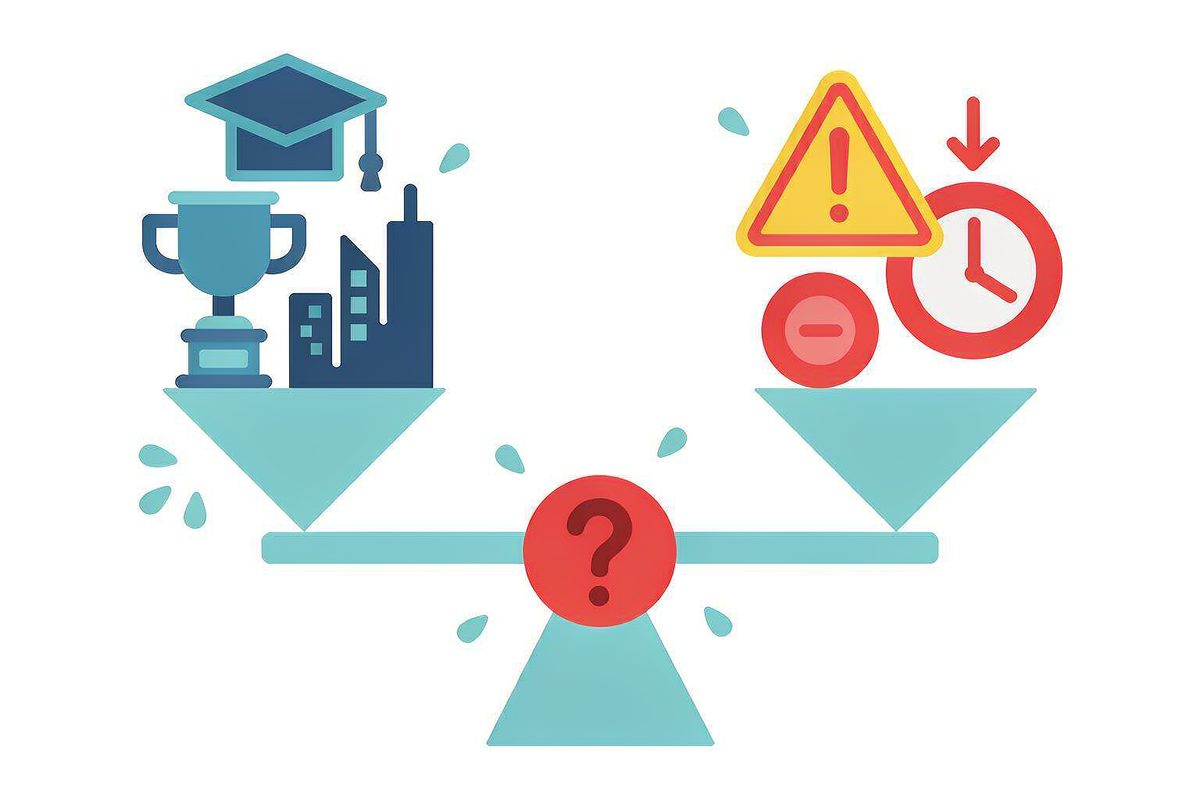
As consultants with 12 years in the industry, NEXAGAIN has seen far too many failed cases of families following the crowd. Parents are drawn in by QS rankings and the 'bilingual environment' filter, and overlook the other side of the picture.
This article isn't about how good studying in Singapore is — there's already plenty of that out there. We're covering the other side: which families it doesn't suit, and which expectations won't be met. Not to talk you out of it, but to help you make a clear-headed decision before committing over a million.
01 / GUIDE
Doesn't suit #1: Families with an annual budget below RMB 150,000
The real numbers
Based on NEXAGAIN's school-by-school verification of 50 institutions:
- Public universities (after bursary): tuition RMB 110,000–250,000/year + living costs RMB 120,000–220,000/year = total budget RMB 230,000–470,000/year
- Polytechnics: tuition RMB 73,000/year + living costs RMB 120,000–200,000/year = total budget RMB 190,000–270,000/year (the lowest entry point)
- Private institutions: tuition RMB 60,000–200,000/year + living costs RMB 120,000–220,000/year = total budget RMB 180,000–420,000/year
With an annual budget below RMB 150,000, even a polytechnic is hard to cover. Some say 'you can work part-time to top up', but in 2026 international students may legally work only 20 hours a week, earning around S$800–1,500 a month — not enough to cover the shortfall in tuition.
Don't be misled by the numbers: some articles claim 'public university tuition is RMB 100,000 a year', which ignores living costs. Accommodation is the biggest drain on your wallet in Singapore — on-campus housing costs S$1,200–2,100 a month (and places are extremely limited), while an off-campus single room runs S$1,500–3,500 a month (about RMB 8,100–18,900). Accommodation alone can cost RMB 100,000–200,000 a year.
02 / GUIDE
Doesn't suit #2: Weak English and no willingness to improve it
Myth: 'If your English isn't good, you can use Singapore as a transition'.
This is one of the biggest misconceptions. Public universities in Singapore teach entirely in English, with no buffer period. NUS and NTU require IELTS 6.5–7.0, and SMU's business programmes require 7.0+. Students with weak English face double pressure once they start: they can't keep up with the course, and they have to cope with daily life at the same time.
Private institutions do run language classes, but they aren't cheap (typically S$3,000–8,000 per level) and the drop-out rate is not low. More importantly, language classes lengthen your studies — effectively adding a year of living costs.
03 / GUIDE
Doesn't suit #3: Chasing rankings without looking at course fit
NUS (QS #8) and NTU (QS #11) have an overall master's acceptance rate of about 8.3%; for popular fields such as computing and finance it's under 5%. High-scoring students from Project 985, C9 League and top 211 universities crowd the applicant pool.
Applying blindly to CS/BA = being an also-ran
NEXAGAIN has seen this far too often: a student from a non-985/211 university with an average of 82 insists on applying to NUS computing and ends up with seven rejections. With the same profile, applying to social sciences at SUSS or engineering at SIT would have given a far better chance of admission.
Think in categories across 50 institutions: don't fixate on NUS and NTU. Among the 50 institutions NEXAGAIN covers are 6 public universities (not just NUS and NTU), 5 polytechnics, 14 international schools and 14 graduate schools. Fit matters more than ranking.
04 / GUIDE
Not suitable (4): expecting 'study abroad = PR'
Settling in Singapore is far from as simple as the marketing suggests.
- EP threshold: S$5,600/month (2026), hard for fresh arts and business graduates to meet. Rising to S$6,000 in 2027
- COMPASS score: Meeting the salary threshold alone does not secure an EP; you also need to pass a 40-point assessment across four dimensions.
- PR approval: ICA does not publish its scoring criteria and gives no reasons for rejection—the process is a black box.
- Limited local market: Starting salaries in Singapore for non-in-demand fields are not necessarily better than in Shanghai or Shenzhen.
The NEXAGAIN founder's own journey—from graduating from SUSS to working and then getting PR—shows the route can work, but it took years. Any agency promising 'study abroad = PR' should be blocked outright.
05 / GUIDE
Not suitable (5): low stress resilience in the child
Academic pressure is no lighter than in China.
Public universities in Singapore are academically demanding—fast-paced semesters, frequent assessments and fully English-taught classes with no adjustment period. A failed module must be retaken, costing about RMB 20,000+ per module. One-year taught master's programmes are even tighter: 'spend the first semester adjusting, then the second semester hunting for jobs in the autumn recruitment round.'
In popular NUS/NTU programmes, Chinese students make up a high proportion of the class, and group assignments often end up with Chinese classmates teaming up together—so it is effectively the same competition with top peers in a different location. Any edge you might have built at other study destinations can easily disappear here.
06 / GUIDE
On the flip side: these families are a great fit for Singapore.
The right profile
- Annual budget of RMB 300,000+ and clear goals: enough to cover the full cost of a public university (after the tuition grant).
- Budget of RMB 150,000–250,000 + a pragmatic polytechnic choice: a three-year Diploma costs RMB 220,000 in total, with dual pathways to employment and degree progression after graduation.
- A resilient child with solid English: able to adapt to a fast-paced academic environment.
- Planning two years ahead: preparing language test scores, profile-building and application materials in advance.
- Clear goals (stay in Singapore / return to China / move on to Europe or the US): not 'taking it one step at a time', but knowing exactly what you want.
How does NEXAGAIN decide whether a family is a good fit?
Drawing on 12 years and 14,719 client interactions, we have built a four-dimensional assessment model: budget fit, the child's academic and psychological readiness, clarity of goals, and pathway fit. The assessment is free and there is no sales pitch—that is our definition of responsible study-abroad consultancy.
Is this article trying to talk you out of it?
No, it is not meant to discourage you—it is to help you make a clear-headed decision before committing RMB 1 million or more. NEXAGAIN is a study-abroad service provider, but we would rather sign one fewer client than see a family make the wrong decision. If it is a fit, we will give it our all; if not, we will tell you honestly.
What are the most worthwhile subject areas for studying in Singapore?
From an employment and staying-in-Singapore angle: computing/AI/electronic engineering/semiconductors are in-demand fields, with starting salaries that can reach the EP threshold. From a return-to-China angle: business/finance/accounting carry strong recognition. From a value-for-money angle: the polytechnic engineering Diploma → degree pathway is the most reliable route.
Can students from non-985/211 universities get into NUS/NTU?
You can try, but the admission rate is very low (8.3% overall). We recommend students from non-985/211 universities with an average score of 85+ also apply to SMU/SUSS/SIT/SUTD as safety options. NEXAGAIN's coverage of 50 institutions can help you find choices with a better fit.
With an annual budget of only RMB150,000, is studying in Singapore really out of reach?
The minimum annual budget for a polytechnic is around RMB190,000 (tuition RMB73,000 + living costs RMB120,000), so RMB150,000 does leave a shortfall. But you could apply for the MOE Tuition Grant (which also applies to polytechnics), or take an on-campus job (up to 20 hours a week of legal part-time work). Speak to a NEXAGAIN consultant for precise budget planning.
07 / GUIDE