

In-depth review: scoring 380 in the Gaokao and turning down a diploma place,
what is it like to complete an Irish bachelor's degree in Dublin within 28 months in Singapore?
This is Case Review #1 from NEXAGAIN's real progression cases
Case 1: How a 380-score humanities student broke into business
1. The student's starting profile
Student A graduated from an ordinary high school in Shandong. A humanities student with consistently weak results, A scored just over 380 in the Gaokao — below the local undergraduate cut-off. A's Gaokao English score was 65 and maths was weak; A was reluctant to work with numbers but was a willing communicator with a genuine interest in business concepts.
2. The family's initial concerns
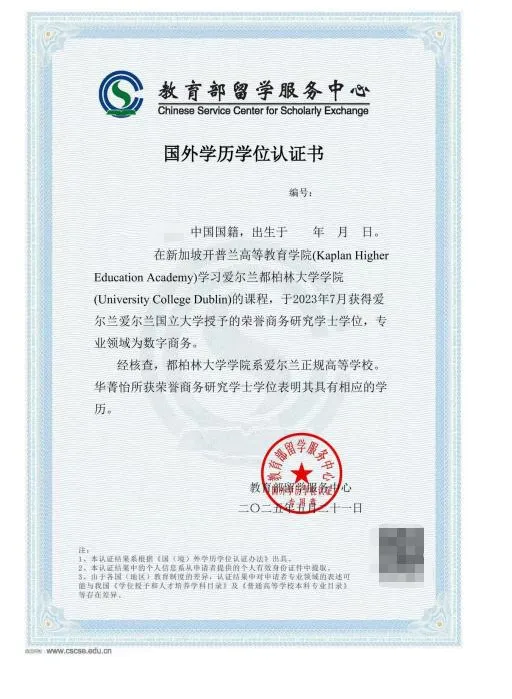
Qualification compliance risk: The parents were deeply worried that studying at a private university overseas meant a “diploma mill”, that the Chinese Service Center for Scholarly Exchange (CSCSE) under the Ministry of Education would not recognise the degree, and that it would fail political vetting for public-sector employment.
Language and academic gap: A's Gaokao English was only in the 60s, and the parents feared their child would not follow lessons taught entirely in English, would fail to complete coursework and would be sent home.
Safety and cost overruns: They worried about the overseas environment and that costs would become a bottomless pit, beyond what an ordinary middle-income family could bear.

3. Why we did not simply take the original route
Under China's centralised admissions system, A could only be placed at a private diploma college. Even if A later progressed through the top-up degree route, that would mean three years of diploma plus two years of degree — five years in total; and with top-up places shrinking and competition intensifying, the time and opportunity costs are very high. Repeating a year was ruled out too: the psychological pressure was heavy, the maths weakness was obvious, and the family judged the potential score gain to be very limited.
4. How we shortlisted Singapore programmes
Ruling out maths-heavy academic institutions: The University of London programmes offered through SIM (Singapore Institute of Management) were excluded outright, because scripts are sealed and sent back to the UK for marking, with extremely demanding assessment in maths, statistics and long academic essays — Student A would very likely have failed and retaken modules year after year.
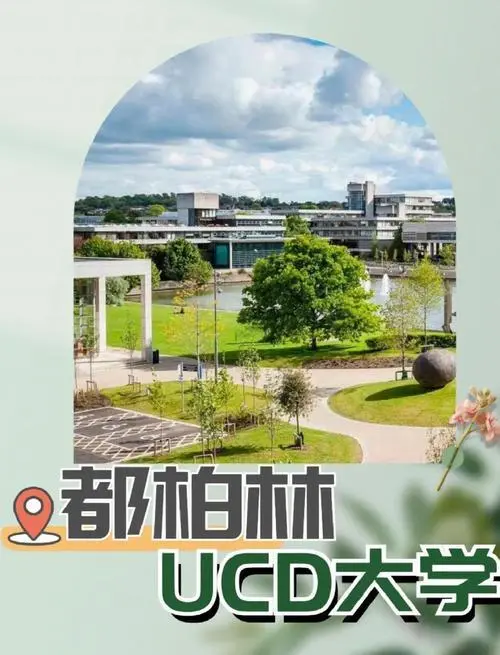
A practical business degree with balanced assessment: The family chose the Bachelor of Finance from University College Dublin (UCD) — triple-accredited by AACSB, EQUIS and AMBA — delivered through Kaplan. The programme is built around individual assignments and group presentations, with balanced weighting for closed-book final exams, runs only 24–26 months, and suits A's study habits closely.
5. Application and planning process
Upfront transcript assessment: A's full three-year, six-semester high school transcript was reviewed; the weighted average came to 72%, meeting the entry threshold for the International Year One.
No IELTS preparation needed: Instead of a short-term IELTS cramming plan in China, A booked the institution's online academic English test and was placed at Level 3 of the language programme (four months).
Three connected stages: four months of intensive academic English ➔ eight-month Diploma in Business (International Year One) ➔ 16-month UCD Bachelor of Finance degree.
On-the-ground academic monitoring: While in Singapore, A was kept to an attendance rate above 95% to keep the Student's Pass (STP) fully compliant, and the consultant helped A choose electives assessed more through case analysis.
6. Outcome
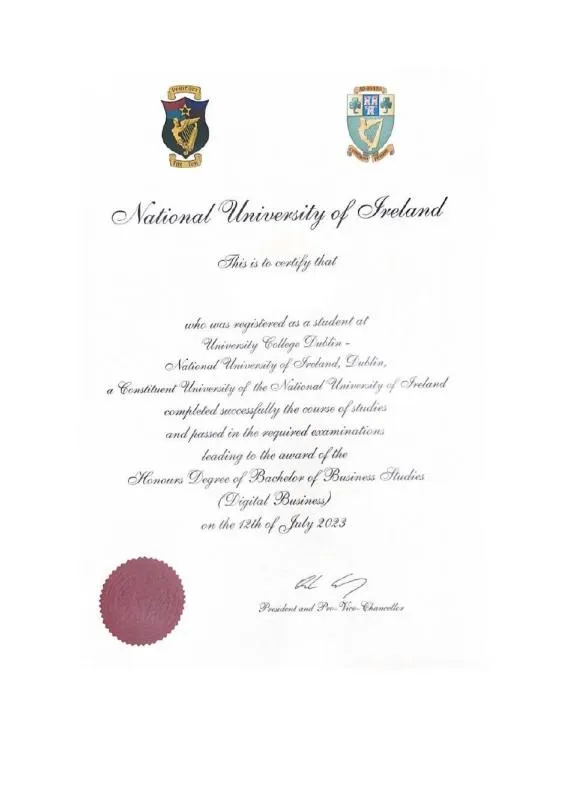
After 28 months, A completed all credits and was awarded the bachelor's degree from University College Dublin. Back in China, the degree passed full-time recognition by the Chinese Service Center for Scholarly Exchange at the first attempt. A then used the English-medium instruction (MOI) letter that comes with a Commonwealth bachelor's degree to waive IELTS and gained direct entry to a master's at the University of Bristol, a QS top-100 UK university.
7. What cannot be copied (non-replicable factors)
Such high attendance and coursework commitment cannot be replicated: A started from a weak base but never skipped a class in Singapore, revising every group assignment repeatedly to the tutor's requirements. A student with poor self-discipline, gaming habits or attendance below 90% risks having their Student's Pass revoked by ICA and being sent home at any time.
The family's decisiveness cannot be replicated: Within two weeks of results day, the family had a clear plan and had secured both a test slot and a place, without being pulled back and forth between repeating the Gaokao and a diploma college — securing a place in the earliest batch for the autumn intake.
---
[Planner of this article]
Xiao Aifeng
• Founder of NEXAGAIN PTE. LTD., Singapore
• 12+ years in education and progression planning and in advising families through China's secondary and tertiary entrance exams; based in Singapore
• Specialises in pathway assessment for Singapore private universities, public universities, secondary vocational progression and master's applications
• No hard selling — objective pathway diagnosis grounded in each student's grades and the family's budget
[Consultation and assessment]
To assess which Singapore institution is the right fit for your three-year high school transcript, vocational school records or university GPA:
👉 Follow our WeChat official account and send “Transcript assessment” in a direct message; the team will arrange a one-to-one preliminary review.

Schools, programmes, fees, entry requirements and accreditation details change. Before applying, always rely on the latest pages published by the specific institution or official body.