

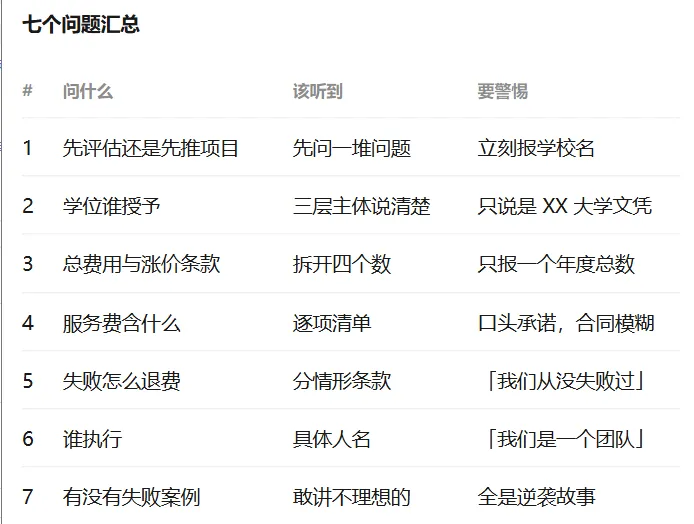
The short answer first: you don't need to look at how many years an agency has been around, how many students it has placed, or how big its office is. Just ask 7 questions before you sign, and see whether it dares to answer them straight.
These 7 questions aren't made up. They map to the 7 points in an application where things most often go wrong: assessment, degree, fees, scope of service, refunds, who actually delivers the work, and whether the case studies are genuine.
Here's each one, including what you should hear and what should put you on alert.

Question 1: Will you assess me first, or push a programme at me first?
Why ask: This is the first dividing line between an adviser and a salesperson.
A proper process starts with understanding the student's qualifications, grades, English level, subject preference, budget and timeline — then working out which pathway fits. If, on the other hand, the other side is already naming three schools before you've finished describing your child, those three names are probably this month's recommended programmes, not the best fit for your child.
What you should hear: a string of questions first — they may even ask for transcripts.
Watch out for: "We've handled plenty of cases like yours, just apply straight to XX."
Question 2: For this programme, who awards the degree?
Why ask: the vast majority of private institutions in Singapore don't award degrees themselves. The course you take is usually licensed by a UK, US or Australian university, and the degree is awarded by that university.
This sounds like a detail, but it actually determines three things: whose name appears on the certificate, whether the qualification can be authenticated, and whether it will be recognised when you apply for a master's later.
What you should hear: a clear three-layer answer — who runs the institution, who delivers the course, who awards the degree.
Watch out for: a vague "it's an XX University qualification" with no full name for the awarding body.
Question 3: What's the total cost, how many instalments, and what do the price-increase clauses say?
Why ask: When money goes wrong in overseas study, it's almost never because it's "expensive" — it's because it "wasn't fully counted" or "went up midway".
The question isn't "how much per year" but four figures: the total programme cost, how many instalments, when each instalment is due, and exactly what the contract says about price increases.
What you should hear: Tuition, miscellaneous fees and one-off costs broken down separately, plus a proactive nudge to check the official fee pages yourself.
What should raise a red flag: One lump sum — “about X a year” — and, when you ask for details, “we’ll let you know nearer the time.”
Question 4: How much do you charge, what’s included and what isn’t?
Why ask: The trap with service fees isn't the amount — it's the boundaries.
"Includes application service" could mean school selection, essays, online applications, visa, airport pickup and accommodation — or it could mean online applications only. If it isn't written down clearly, every item afterwards can become an extra charge.
What you should hear: A clear service list, itemising what’s included and what isn’t.
What should raise a red flag: Plenty of verbal promises, but the contract says only “provision of overseas study consultancy services.”
Question 5: If the visa is rejected, or my child gets no offers at all, how does the refund work?
Why ask: This is the one question that reveals whether they are honest.
Application outcomes carry a real risk of failure: a visa may be rejected, and not a single programme may make an offer. A reputable agency will set out in the contract the refund percentage and timeline for each scenario.
What you should hear: Clear refund terms for each scenario, written into the contract.
What should raise a red flag: “We’ve never had a failure” or “Don’t worry, there won’t be any problem.”
The phrase “we’ve never had a failure” is itself the biggest risk signal there is.
Question 6: Who will handle our case? Is it the person I’m speaking to now?
Why ask: Switching staff between signing and delivery is common industry practice.
A senior consultant handles the conversation, then the case is passed to a newly hired assistant. This isn't so much an ethical issue as a capability mismatch — the person executing may have no idea how to deliver what was promised.
What you should hear: The name of the person who will actually handle the case, and how often you’ll hear from them.
What should raise a red flag: “You’ll be served by a team.” A team is the easiest way to make sure nobody can be found.

Question 7: Can you show me three cases similar to my child’s, including ones that didn’t succeed?
Why ask: The real test of a case study is whether they dare to show the failures.
With an agency that only shows successes, you can't tell where its limits lie. One that is willing to discuss failures usually tells you two things: it genuinely runs applications, and it knows where the risks are.
What you should hear: Specific profiles and specific outcomes, including disappointing ones.
What should raise a red flag: Nothing but vague “against-all-odds” and “low scores, top offer” stories, and “that’s private” as soon as you ask for details.
One last word
Once you’ve asked these seven questions, you’ll get one of two reactions. Either they answer seriously — and may even ask you more questions in return — or they sidestep and start emphasising how many years they’ve been in business.
The first is assessing your child. The second is assessing you.
Choose the first.

Author: Xiao Aifeng (Ivy Xiao), NEXAGAIN, a Singapore-based pathway planning consultancy. The processes described here reflect our own way of working and are not an industry standard; always rely on the written contract terms of each agency.
Schools, programmes, fees, entry requirements and accreditation details change. Before applying, always rely on the latest pages published by the specific institution or official body.