
In-depth review:
Breaking the bias:How a public vocational school student earned a bachelor's degree from a top 200 global university in 28 months,and successfully passed the preliminary public-sector review?
This is the second instalment of NEXAGAIN's real admissions case reviews
Case 2: How a vocational school computer major beat the odds in engineering
1. The student's starting profile
Student B is a recent graduate of a public vocational technical school (ordinary secondary vocational school) in Guangdong, where they majored in Computer Application Technology. A serious subject imbalance in lower secondary led to streaming after the Zhongkao; over three years at the vocational school, their combined average across academic and specialist subjects was about 75, with no prior exposure to standardised language tests such as IELTS or TOEFL.
2. The family's initial concerns
Credential bias: Parents feel self-conscious about their child's vocational certificate background, believing that overseas public universities or top-ranked institutions would never accept a vocational school student, and worry about being lured in by unscrupulous agents under the guise of a "study tour".
Visa and background checks stall: Concerns that the Singapore immigration authorities do not recognise vocational certificates, leading to a rejected student visa application.
Can't follow the computing theory: Although he had written basic front-end code at school, he worried that overseas English-medium university courses in computer science and data structures would be too demanding.
3. Why we did not simply take the original route
In China, sitting the single recruitment exam for vocational colleges only allows entry to local vocational institutions, and graduates still carry the private vocational college label in the job market. On top of that, Student B has a strong self-driven interest in the underlying logic of computing and cybersecurity, and the practical hardware and course depth at Chinese vocational colleges could not meet his need to advance his technical skills.
4. How we shortlisted Singapore programmes
Credential verification and pathway alignment: confirm how Singapore's private education regulator recognises vocational secondary qualifications, and establish whether an applicant with a complete 12-year formal school record can be treated as equivalent to a senior high school qualification.
Locking in institutions strong in hardware and engineering: Ruled out purely business-focused providers and selected Singapore's PSB Academy, which has strong engineering and STEM facilities, articulating to the University of Newcastle (Australia) Bachelor of Cybersecurity and Computer Science (QS top 200 globally). The campus has Singapore's high-spec cybersecurity labs, and practical credits make up a large share of the programme.
5. Application and planning process
Formalising the vocational school record: Assisted Student B in properly obtaining a complete transcript covering 3 years and 6 semesters from the academic affairs office of his school, and notarised the graduation certificate and transcripts at a notary public with foreign-related qualifications.
Closing the language gap first: Passed the school's own entrance test and completed a 4-month academic English progression course, with a focus on computing terminology and the logic of English academic writing.
Stepped academic transition: An 8-month Diploma in Information Technology laid the foundations of programming and algorithms; after passing the final assessments, he progressed directly into the 16-month University of Newcastle degree.

6. Outcome
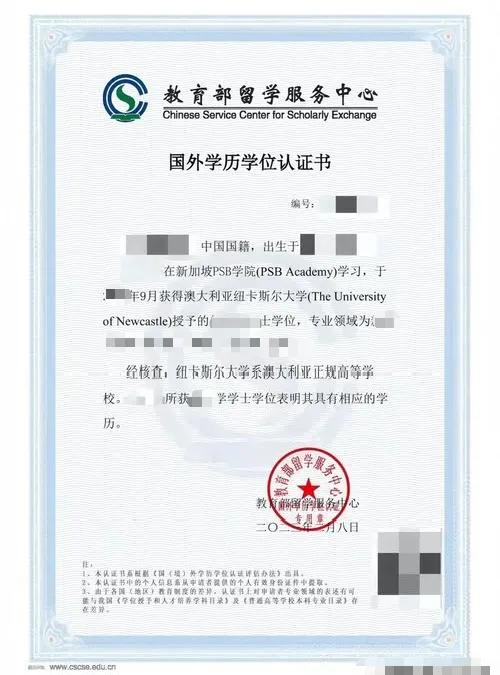
Student B completed all courses in 28 months and was awarded a full-time Bachelor's degree by the University of Newcastle (Australia), which was certified by the Chinese Service Centre for Scholarly Exchange on his return to China. With a full-time bachelor's degree and a directly relevant computer network security major, he passed the preliminary application review and the political vetting and record registration for an IT post at a prefecture-level public institution in his hometown.
7. What cannot be copied (non-replicable factors)
The public vocational school's compliant record cannot be replicated: Student B attended a formal public vocational secondary school under the education authorities, which could properly issue Chinese and English subject transcripts stamped with the academic affairs office seal. This pathway would not work with a private short technical training course without degree-granting status, or with a technician certificate that cannot be verified in the human resources and social security system.
The individual's hands-on aptitude and self-drive cannot be replicated: Student B was strongly self-motivated about coding and spent time in the lab on project work after class. If a student dislikes STEM subjects and lacks computational thinking, choosing an engineering programme blindly carries a very high risk of failing the final coding assessments.
[Planner of this article]
Xiao Aifeng
• Founder of NEXAGAIN PTE. LTD., Singapore
• 12+ years in education and progression planning and in advising families through China's secondary and tertiary entrance exams; based in Singapore
• Specialises in pathway assessment for Singapore private universities, public universities, secondary vocational progression and master's applications
• No hard selling — objective pathway diagnosis grounded in each student's grades and the family's budget

[Consultation and assessment]
To assess which Singapore institution is the right fit for your three-year high school transcript, vocational school records or university GPA:
👉 Follow our WeChat official account and send “Transcript assessment” in a direct message; the team will arrange a one-to-one preliminary review.
Schools, programmes, fees, entry requirements and accreditation details change. Before applying, always rely on the latest pages published by the specific institution or official body.