

Twelve years in this industry, thousands of questions asked. These 8 come up most often.
There are plenty of 'standard answers' to these 8 questions online — and most are wrong. Not because the facts are wrong, but because they hand you a conclusion that ignores your situation.
We answer differently: first say 'it's not X', then say 'it's Y', and finally say 'it depends on Z'.

1. 'If my child's grades are poor, is it hopeless?'
It's neither 'hopeless' nor 'fine' — you have to look at what exactly is 'poor'.
Is the overall score low but with strong subjects? Are a few subjects dragging it down? Weak in exams but solid on day-to-day coursework? Is English pulling down everything else? Each of these four calls for a completely different response.
It depends on: the exact score breakdown, how the target programme assesses applicants, and how much time is left to close the gap.
2. 'Are private universities just diploma mills?'
No. Private education in Singapore sits within a clear regulatory framework: legitimate institutions must hold the relevant licences, and their courses must be approved.
But 'not a diploma mill' doesn't mean 'all equally good'. Private institutions vary widely, mainly in three areas: who awards the degree, whether the course is recognised, and where past students actually ended up.
It depends on: who awards the specific programme, and whether it is recognised in the context you need it for.

3. 'How much does one year actually cost?'
We won't give a single figure — we'll give you the structure. Because 'how much per year' is the wrong question: programmes differ in length, payment schedules differ, living arrangements differ, and an annual number isn't comparable across them.
Look at four things instead: total programme cost (not the annual figure), living costs (accommodation is the big one), one-off expenses (application, visa, medical check-up, flights, deposits), and possible extras (retakes, extensions, exchange-rate swings).
It depends on: the total programme length, the accommodation you choose, and how well the family can absorb an 'unexpected extra year'.
4. 'Can my child stay in Singapore to work after graduating?'
No one can promise that — and no one should. Singapore has its own assessment process for international graduates seeking employment, and it doesn't map neatly to which school you attended.
What we can tell you: which fields are more in demand in the local industry, which pathways are better for building local experience, and when to start preparing.
Depends on: your field of study, personal ability, and the policy environment that year — and no one can control that last one.
5. 'What if my English isn't good?'
First, distinguish between 'not doing well in exams' and 'not understanding lectures'. These are two different problems.
Not doing well in exams can be improved through training; not understanding lectures means your language ability isn't yet at the level needed for academic study, and requires longer language preparation.
If the latter is skipped and you go straight into subject courses, there's a high chance you'll struggle in the first year.
Depends on: your actual current English level (not exam scores), the real language requirements of the programme, and whether you're willing to spend an extra six months to a year.
6. 'When is the right time to start preparing?'
There's no universal answer, but here's a criterion: work backwards from your target intake date and see how many steps are left.
If your target is to enrol in two years, starting now gives you plenty of time. If your target is to enrol in six months, what you need isn't 'preparation' but 'choosing the most feasible option under your current circumstances'.
Depends on: your target intake date, which requirements you currently lack, and how long each takes to fulfil.

7. 'Will an agency cheat me?'
Yes. There are indeed practices in this industry that profit from information asymmetry.
But whether you get cheated isn't entirely down to luck — it largely depends on what you ask. Ask 'How many years have you been in business?' and you get a story; ask 'Who awards the degree for this programme, and what are the refund terms?' and you get information.
Depends on: whether you're willing to ask seven more questions before signing.
8. 'What if my child doesn't want to go?'
This is the hardest one, and it's usually not a study-abroad issue but a family communication issue.
A child who is sent abroad by arrangement has little inner motivation to push through difficulties in a foreign country. And difficulties are inevitable on this path.
Our approach: involve the child in the assessment process, let them hear the real information (including risks and costs), not just 'going abroad will solve everything'.
Depends on: what the child really thinks, and whether the family is willing to spend time on this rather than just money.
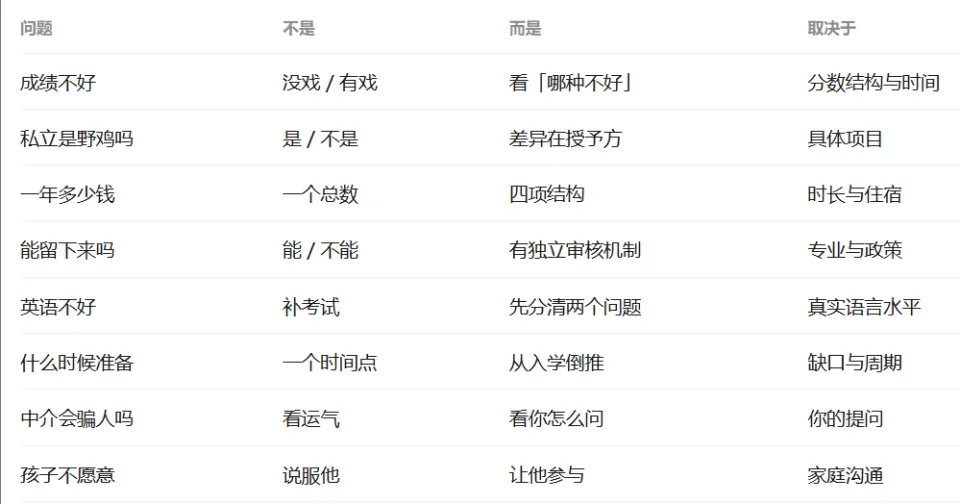
Eight questions, one table
Why we don't give standard answers
Because the cost of a standard answer is that it makes you think the problem is solved.

The truly difficult part of the study-abroad decision is never 'which school is good', but 'given your imperfect circumstances, which path's risks can you bear'. There's no universal answer to this — it can only be discussed case by case.
NEXAGAIN|This article is general information only and does not constitute any guarantee of admission, accreditation or employment for any specific programme. Website: nexagainsg.com
Schools, programmes, fees, entry requirements and accreditation details change. Before applying, always rely on the latest pages published by the specific institution or official body.