There is a saying circulating in the study abroad circle: Choosing a major is like buying stocks. You are most afraid of chasing the highest point, but just hitting the trough.
In recent years, many Chinese families studying abroad have set their sights on Singapore, coming for the international education system and relatively friendly immigration environment.
But few people have noticed that in this seemingly stable educational landscape, the replacement of hot and cold majors is quietly accelerating.
National University of Singapore (NUS), Nanyang Technological University (NTU), and Singapore Management University (SMU), the three most representative universities in Singapore, have all experienced a drastic professional reshuffle in recent years.
The once "iron rice bowl" accounting major is in decline, engineering and humanities and social sciences continue to cool down, while computer-related majors are booming.
This change is not only a multiple-choice question for local students in Singapore, but also a practical issue that every family who is planning a study abroad path cannot avoid.
When the traditional "safe choice" is no longer safe, how should families studying abroad understand the logic behind this change?
https://inews.gtimg.com/om_bt/OCfA4r1lxvBUp4-u01Qd6eLJiiV5OPdd4Cu9dkYNCbWucAA/641 From “iron rice bowl” to “hot potato”: Accounting, engineering, humanities and social science collectives are in the cold
For a long time, parents have generally believed that no matter whether the economy is good or bad, companies need people to manage money. Finance and accounting majors are almost a "guaranteed income" existence.
In the past two decades, accounting has indeed been one of the flagship majors with the highest admission threshold and the most sought-after in the NUS, NTU, and SMU business systems. But this once “golden rice bowl” major is now experiencing a significant cooling down. https://inews.gtimg.com/om_bt/OEcTCabkYPTvKy3AZhjpNYL7iOPNEg249KRLivHEn56t0AA/641
The number of students enrolled in accounting majors in Singaporean universities continues to decline.
Research by the Institute of Singapore Chartered Accountants (ISCA) shows that the number of registrations for the accounting profession dropped by more than 10% between 2018 and 2023.
Statistics from education platform SGSchoolKaki also confirm this trend. The number of enrolled students majoring in accounting dropped from 4,982 in 2020 to 3,995 in 2024, a decrease of approximately 20% in four years.
It’s not just accounting that’s in trouble, the situation for humanities and social science majors is also not optimistic.
The NUS Faculty of Arts and Social Sciences (FASS) had 6,400 undergraduate students in 2019, making it one of the largest faculties in the school at that time. By 2025, this number has dropped to about 4,000, a drop of nearly 40%.
NTU's College of Humanities, Arts and Social Sciences (CHASS) currently has about 3,965 students enrolled, including 482 in psychology and 370 in sociology. The number of students in SMU's School of Social Sciences is even smaller, with only 957. https://inews.gtimg.com/om_bt/OgJksffg9ANAxFXymCBzdCQKeZcV3J1oO0GdIJk8vS75QAA/641
The once-famous engineering major has also gradually lost its halo in the hearts of students.
According to data from the Singapore Ministry of Education, about 40% of Singaporean college students chose engineering science-related majors in 2005. By 2024, this proportion had dropped to about 23%.
A similar trend is seen at the polytechnic level, with the proportion of enrollment in engineering science-related majors falling from around 38% to around 26%.
It is worth noting that the decrease in proportion does not mean an absolute decrease in the number of people. Due to the expansion of the overall enrollment scale of universities, there were approximately 17,800 students studying engineering majors in 2020, but this will increase slightly to approximately 19,200 students in 2024.
In the 2025/26 academic year, the NUS College of Design and Engineering (CDE) has a total of 5,769 students, which is basically the same as the 5,761 students in the previous year; the NTU College of Engineering has 7,322 students, including 1,678 in mechanical engineering and 2,454 in electrical and electronic engineering.
In other words, the "plate" of engineering majors has not shrunk significantly, but its attractiveness ranking in the minds of students is indeed retreating.
In stark contrast to the cooling of these majors, there is the continued expansion of computer majors. https://inews.gtimg.com/om_bt/OEypXE4YIX9r3_EKPKSVq0FjvPiOhDzH0O_Eh6bHVq42sAA/641
The number of students enrolled in computer-related majors in Singaporean universities is increasing year by year.
From 2021 to 2025, the comprehensive enrollment of NUS School of Computing-related programs will increase from 4,860 to 6,348, an increase of approximately 31%.
Singapore Management University The total enrollment of SMU's four computing-related degree programs in computer science, information systems, software engineering, and computing and law has also increased from 1,999 students in 2021 to 2,518 students in 2025, an increase of approximately 26%.
The biggest growth is in computer science itself.
From 2019 to 2024, the cumulative number of students in computer-related programs at NUS, NTU, and SMU has increased by approximately 63%.
SMU's computer science program was only established in 2019. In 2021, it enrolled only 246 students. By 2025, it had increased to 569 students, more than doubling in size.
Professor Pan, dean of SMU’s School of Computing and Information Systems, once lamented that the number of students applying for IT-related majors has exploded in recent years, and the number of applicants has far exceeded the school’s carrying capacity.
https://inews.gtimg.com/om_bt/Ouo9JfV4BtRFwORL7-Ca3VsBu6TcQNlXzKqZ5CDEI_Kt0AA/641 It’s not that computers “stole” jobs, but that the job market changed first.
Seeing this string of numbers, it is easy to draw a simple conclusion: Computers are popular, and other majors are in misery.
But if you look at it from another angle, this is more like a collective rational response of young people to job market signals, rather than a blind follow-up trend.
The reason why computer majors continue to rise is primarily due to the direct attraction of high salaries.
Google, Meta and local financial technology companies have continued to extend their olive branches in recent years, and the monthly salary of fresh graduates often starts from SGD 6,000.
The latest graduate employment survey also confirms this: graduates majoring in information and digital technology have a full-time employment rate of around 88% within six months of graduation. The median monthly salary generally exceeds SGD 5,500. Computer science projects in some leading universities can even reach around SGD 6,400.
Coupled with the popularity of AI tools such as ChatGPT, the popularity of artificial intelligence and data science has been further ignited. Today’s students prefer programs that combine programming with practical applications such as cybersecurity and algorithmic trading.
https://inews.gtimg.com/om_bt/O77TfXq3DKUF_YDu-2JjWrDJEy9maXnYKDqU5LbVDUlqsAA/641 Major universities are also rapidly adjusting course layouts. NTU has launched AI and Society degree courses and the Turing AI Scholars program, while NUS has embedded AI modules in multiple majors.
It can be said that AI is changing from an independent professional direction to a general ability that everyone must master in university education.
In contrast, there are other reasons for the cooling in engineering majors. On the one hand, there is a significant gap in starting salaries. The median monthly salary in engineering is about 4,200 Singapore dollars, which lags behind that of the computer industry. On the other hand, some positions are physically demanding, and the technology iteration speed in traditional industries is relatively slow.
Although Singapore's Ministry of Manpower lists civil engineering and industrial engineering as in-demand positions and is highly dependent on foreign talents, salary levels, working environment and career development speed are becoming more important factors for students when choosing a career. To this end, the industry is also calling for reshaping the attractiveness of engineering majors through interdisciplinary integration. For example, NTU's "Renaissance Engineering Project" combines engineering with business or computing.
The situation of the accounting profession is even more complicated.
The popularity of automated auditing and AI tax filing tools has indeed made many students anxious about the future of this industry. However, experts generally point out that professional judgment in complex scenarios is still inseparable from human experience.
At present, the employment rate of accounting majors is about 88%, and the median monthly salary is about SGD 4,500. The overall performance is not bad. What really causes a headache for the industry is that fewer and fewer graduates are willing to enter firms and take professional practice routes.
As for the popularity of humanities and social science majors, the core reason is doubtful employment prospects. Although the employment rate of graduates from related majors is also about 88%, the median monthly salary is about SGD 4,350, which is indeed unattractive compared with high-paying majors such as computer science.
https://inews.gtimg.com/om_bt/OsoMHP0rLTB9alT7La3CdeCtGCX83UwplstaRZVfEjz6AAA/641 However, humanities and social sciences are not without value. Critical thinking, communication skills, and social insight are still scarce abilities in the AI era.
Now more and more students are taking the initiative to "combine skills", such as majoring in humanities and social sciences, minoring in computer science, or combining majors with communication studies and data analysis.
In the final analysis, this round of changes in major selection is not about computers “replacing” traditional majors, but about young people using their own choices to respond to the real signals released by the job market.
For families studying abroad, instead of worrying about whether their children should learn computers, it is better to think clearly first: whether their children's interests and abilities can find their own place in this change. https://inews.gtimg.com/om_bt/O85LuaGatEsKoICCgDI4-JVkoL1gWZb-VFdVFhfftA1pEAA/641
Don’t just stare at computers, what Singapore is really betting on in the next decade
Having a clear understanding of the current status of majors is not enough to help families studying abroad make long-term judgments. What is really worthy of concern is which industries Singapore plans to focus on developing in the next ten years. This is the more fundamental coordinate system behind professional selection.
An employer brand survey conducted by market research organization Kantar for Randstad in January 2026 showed that among the top ten best employers in Singapore, Singapore Airlines ranked first, followed by Changi Airport Group, DBS Group, etc., and companies such as Illumina, Pratt & Whitney, Infineon, and Sanofi entered the top ten for the first time.
From an industry perspective, life sciences became the most attractive field with a score of 75.6, with hotel and leisure services and semiconductor manufacturing ranking second and third respectively. https://inews.gtimg.com/om_bt/OavHwCjZYhXe0fq41QlF5m3pSuZYNRDMNET1g3wkTV7bwAA/641
Singapore's 2026 Best Employers List reflects changes in industry popularity
These changes have revealed several key directions for Singapore’s future industrial layout.
The Economic Strategy Review released in May this year elaborated on this focus more systematically.
The first is artificial intelligence. Singapore does not intend to simply compete to see who can train a larger model, but rather focuses on whether AI can truly be applied to specific industries such as finance, logistics, manufacturing, and medical care.
For international students with non-computer backgrounds, this may be an opportunity to overtake them: in the future, companies will not necessarily need pure algorithm engineers, but compound talents who understand both industry and AI, such as finance + AI, medical + AI, and supply chain + AI.
Instead of struggling to code with computer science students, it is better to combine your professional advantages with AI to find your own cross-track.
The second is the field of cutting-edge technology.
Quantum technology, space, advanced manufacturing, automation, industrial robots and other directions are occupying an increasingly important position in Singapore's industrial landscape.
These directions sound "hard-core", but they are not only accessible to science and engineering students. There is also a large demand for positions such as project management, business analysis, supply chain, and operations.
https://inews.gtimg.com/om_bt/OaHbJicn18VUrKh4sbQzKhGJ20-4lklCV5pranqdtGsZ8AA/641
Singapore is increasing its presence in cutting-edge industries such as quantum technology and advanced manufacturing.
More importantly, Singapore is strengthening its role as a global hub.
In the past, Singapore was more responsible for the transit function of goods and capital; in the future, Singapore hopes to become an important node for multinational companies to lay out the Asia-Pacific market, attracting more regional headquarters, supply chain management centers, financial centers and R&D centers to be established.
There is also a keyword that appears repeatedly in the report: Good Jobs.
Singapore’s future goal is not to simply create more jobs, but to create more high-quality job opportunities with room for development.
Taken together, the truly competitive talents in the future are not "specialists" who only master one skill, but compound talents who can continue to learn, adapt to changes, and solve problems across fields. For parents studying abroad, this may be more worth thinking about in advance than "which major is the most popular."
https://inews.gtimg.com/om_bt/OlZpLfHEFzghQ1CbLs8voPs9k34HSz8tiySAIK2hd_LTwAA/641
There is no major that is always popular, only one who continues to upgrade himself
Facing the ever-changing job market, instead of worrying about the current hotness of majors, it is better to see three more long-term significance of choosing a major.
First, look at long-term demand and don’t just chase short-term hot spots.
Choosing a major should not just depend on which industry is the most popular at the moment, but also whether it will continue to need people in the next ten years or so.
Even within the same technology track, there are huge differences. The information and communications industry has recently been cutting jobs to control costs, but the semiconductor industry continues to hire.
If you just hear about "hot technology" and rush in blindly, you may just step into the trough of the industry.
 The 2025 Joint Graduate Employment Survey of Autonomous Universities in Singapore (JAUGES) shows that the overall employment rate of graduates from public universities in Singapore is approximately 88.9%.
However, the income gap between different majors is still very obvious: the median monthly salary of graduates in humanities and social sciences is about 3,200 Singapore dollars, while that of computer majors can reach 5,800 Singapore dollars.

Second, internship and project experience are becoming a real hard threshold.
In the past, people always thought that as long as they improved their grades in school and got a beautiful diploma, they would be secure in finding a job. But today's corporate recruitment is paying more and more attention to what students have actually done during school.
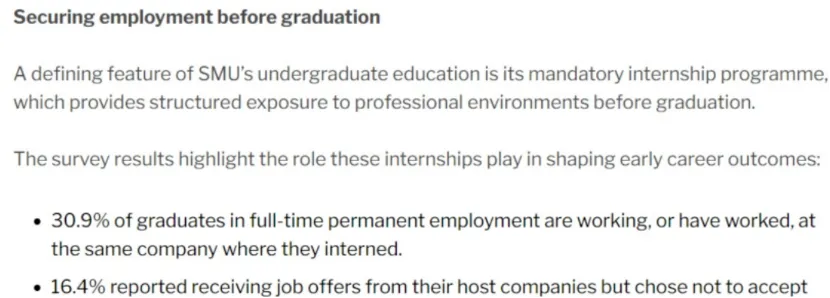
SMU survey data shows that nearly half of graduates have obtained full-time job opportunities through internships, of which 30.9% eventually directly entered the internship company to work, and another 16.4% received a formal offer from the internship company but did not accept it.
Internships are no longer a dispensable extra point on a resume, but a pass that directly opens the door of a company.
For families planning to study abroad, whether they can obtain high-quality internships, scientific research and project opportunities during college needs to be considered with the same weight as school rankings and tuition fees.
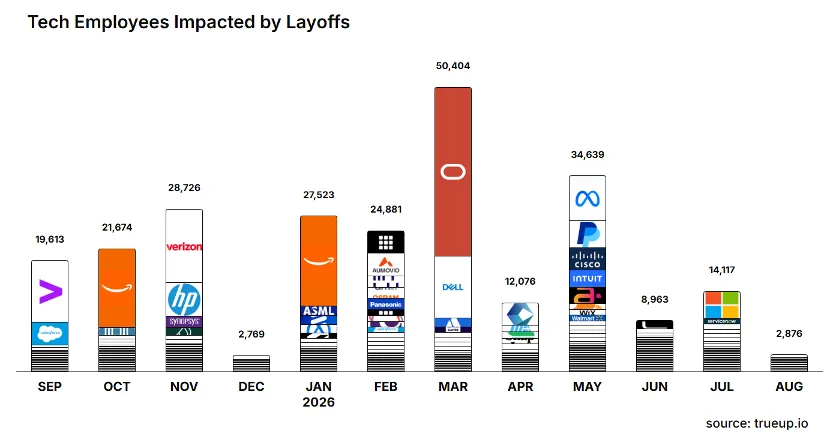
Third, job reorganization is the norm, and self-renewal is the real confidence.
Singapore's Ministry of Manpower pointed out that the main reason for corporate layoffs and job adjustments today is business restructuring.
With the rapid popularization of AI and automation technology, many traditional positions are decreasing, and the ability requirements of the remaining positions are also constantly changing.
No industry can make people happy once and for all. For families studying abroad, choosing a university should not be based solely on rankings, and choosing a major should not be based solely on today’s employment rate. More importantly, it is important to see whether the curriculum keeps up with industry changes and whether the skills students master when they graduate still meet market demand.
The change of majors in Singapore’s universities is, to some extent, a microcosm of the changes in majors in universities around the world.
Faced with the double attack of the temptation of high salaries and the impact of AI, blindly chasing hot spots is easy to "take over from a high point", and the "iron rice bowl" that sticks to the tradition may also fall behind in the changes.
Rather than worrying about which major is the most popular at the moment, helping children find a direction that can continuously update themselves with the iteration of the industry and give them lasting competitiveness may be the best solution for families studying abroad to cope with the changes of this era.

Schools, programmes, fees, entry requirements and accreditation details change. Before applying, always rely on the latest pages published by the specific institution or official body.